

If you’re asking “what is private transfer service,” the practical answer is transport booked for you or your group, rather than shared with unrelated passengers. A driver and vehicle are assigned to your booking, and the journey is arranged around an agreed pickup and destination. That can make it easier to coordinate the trip, especially when you’re travelling with other people or luggage.
Before booking, it’s reasonable to ask what the service includes, where you’ll meet the driver, and whether a dedicated journey suits your plans. Airport transfers can include a meet-and-greet pickup and direct transport to your destination. A private transfer isn’t automatically the right choice for every trip: a taxi, shared shuttle, or public transport may suit a short journey or a tighter budget better.
This guide explains how private transfers work, what to plan from pickup to drop-off, and how they compare with other options. It also covers when a dedicated journey may suit airport, intercity, business, or group travel, so you can choose based on the trip you need to make.
Key Takeaways
- To understand what is private transfer service, focus on the booking: the vehicle is reserved for your party rather than shared with unrelated passengers.
- Have your travel date, time, pickup and drop-off points, passenger count, and luggage details ready when arranging a journey.
- Compare private transfers with taxis, shuttles, and public transport by looking at how you book, whether you share the ride, and how the route is organised.
- Weigh privacy, schedule coordination, group needs, and luggage against the flexibility of shared options.
- Choose a service format to match the trip, from airport and intercity transfers to hourly, business, hotel, crew, and large-group travel.
What Is a Private Transfer Service? The Simple Definition
A private transfer is transport arranged in advance for a specific booking party. A driver and vehicle are assigned to that booking, so your party travels together instead of sharing the vehicle with unrelated passengers. The service may cover one trip between two points or transport arranged as part of a wider schedule.
The question “what is private transfer service” has a practical answer: it describes how a journey is organised, not a specific vehicle type or level of luxury. You reserve transport for your party, with the pickup and destination set out in the arrangement. That can make it easier to coordinate plans, particularly when several passengers are travelling together.
A private transfer is arranged for your party; a shared ride combines passengers from separate bookings. The distinction is who the vehicle is reserved for, not necessarily how formal or premium the journey feels.
Private transfers can connect an airport, accommodation, business destination, or other agreed points. An airport journey can include a meet-and-greet pickup and direct door-to-door transport. These are features of the airport transfer arrangement, not universal elements of every private transfer. Check the pickup instructions in your booking so you know where the trip begins.
A driver is central to the service. The term chauffeur services refers to professional driving, while “private transfer” describes a dedicated journey for a booking party. The ideas often overlap, but the transfer format is defined by the reserved journey and who travels together.
What does a private transfer usually mean?
At its simplest, a private transfer brings together arranged transport, a driver, and a journey for the passengers who made the booking. The booking identifies where and when the trip begins and where it ends. It may cover an airport pickup, transport to accommodation, travel to a business destination, or a connection between other points. The precise inclusions depend on the service arrangement.
Does private mean a luxury car?
No. “Private” describes who shares the vehicle, not its class, styling, or amenities. A dedicated transfer can be straightforward and practical, or provide a more refined level of comfort, depending on the arrangement. Don’t assume that privacy automatically means a premium vehicle, extra amenities, or a formal experience. Start by checking whether the journey itself fits your party and plans.
This distinction makes comparisons clearer. A shared shuttle can be convenient, but passengers from different bookings may travel together. A private transfer keeps the journey for your party, which can help when coordinating luggage, arrival plans, or a group’s onward travel. The service format tells you who rides together; vehicle class tells you what kind of vehicle is used.
How Private Transfers Work, from Booking to Drop-Off
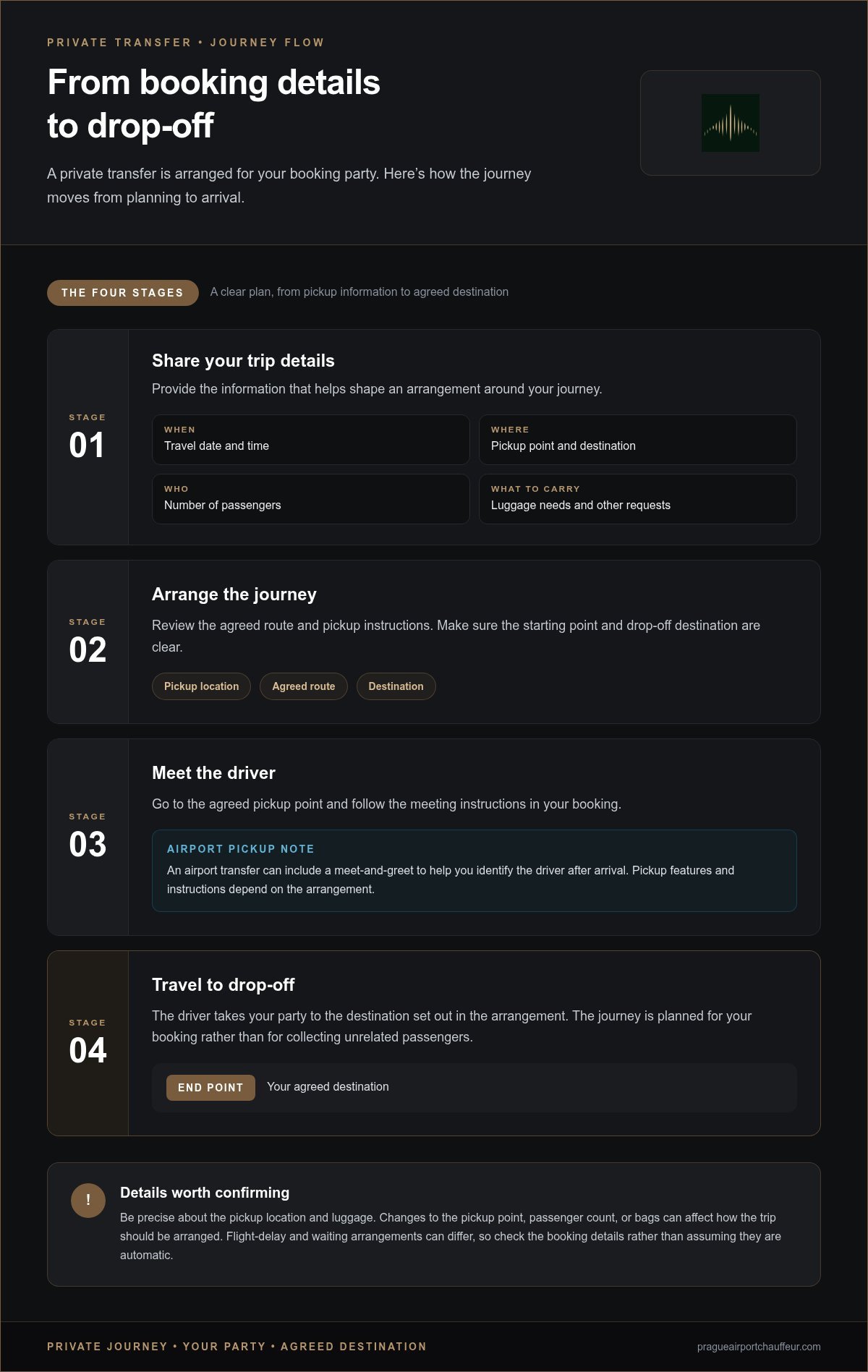
Once you understand what is private transfer service in principle, the process is straightforward: share your trip details, arrange the journey, meet the driver, and travel to your destination. Providing clear information in advance helps establish the pickup and drop-off plan and makes it easier to know what to expect on the day.
- Share your trip details. Provide the travel date and time, pickup point, destination, number of passengers, and luggage needs. These details help shape an arrangement suited to the trip.
- Arrange the journey. Review the agreed route and pickup instructions so you know where the trip begins and where you’ll be dropped off.
- Meet the driver. Follow the instructions for your pickup point. For airport transfers, a meet-and-greet can help you identify your driver after arrival.
- Travel to drop-off. The driver takes your party to the agreed destination. A direct transfer is planned around your booking rather than collecting unrelated passengers along the way.
Arranging the details in advance turns the pickup, passenger needs, and destination into a clear plan before travel day. That preparation can reduce uncertainty, particularly when you’re coordinating several travellers or arriving with luggage.
What details help arrange the journey?
Start with the essentials: pickup and destination, date and time, passenger count, and luggage. Be precise about the pickup location, since an airport meeting point differs from a hotel entrance or business address. Include details of bags that could affect the space needed. If you have another request, add it to the booking information so it can be considered alongside the rest of the journey.
Accurate details matter. A change to the pickup point, passenger count, or luggage can affect how the trip should be arranged. For example, a group with several bags has different practical needs from one passenger travelling light. Sharing the information clearly helps align the booking with the journey and avoids relying on assumptions about amenities or policies.
What happens at pickup and during the ride?
At the agreed time and place, you meet the driver and travel to the destination set out in the arrangement. Airport transfers include meet-and-greet and direct door-to-door transport. Follow the meeting instructions for your pickup. Flight-delay and waiting arrangements can differ, so review your booking details rather than assuming they are automatic features of every private transfer.
Clear arrangements are one reason travellers value private transport. TaxiMom’s overview of the advantages of private transportation discusses tailored service and reliability in a school setting. For airport pickup with a driver meeting you and direct transport to your destination, explore private airport transfers.
Private Transfer vs Taxi, Shuttle, and Public Transport
When comparing ways to reach your destination, focus on three practical differences: how you book, who shares the ride, and how the route is organised. The phrase “what is private transfer service” describes a format arranged in advance for one booking party. A taxi can also take you directly to a destination, but it’s often requested when the ride is needed.
| Transport option | Booking style | Passenger sharing | Journey format |
|---|---|---|---|
| Private transfer | Arranged in advance | Reserved for the booking party | Planned around the agreed pickup and destination |
| Taxi | Often requested for an immediate trip | Usually for the passengers travelling together | Driver takes the passengers to their requested destination |
| Shared shuttle | Booked for a scheduled service | May include passengers from separate bookings | May involve planned stops or pickups |
| Public transport | Used according to the service’s timetable | Shared with other passengers | Follows established routes and stops |
Private transfer or taxi: what is the difference?
The clearest distinction is usually timing and planning. A private transfer is arranged before travel, so the pickup and destination are part of the booking. Many taxi journeys begin with a request for a ride when it’s needed. Both options involve a driver, and either may provide a direct trip. The distinction is whether the journey has been organised in advance for your party.
Advance arrangements can help if you’re coordinating a particular arrival time, travelling with a group, or want pickup details settled beforehand. A taxi may suit a short, unplanned journey where flexibility matters more than planning transport ahead. Neither format is automatically better. Consider how much organisation the trip needs and whether you want transport reserved in advance.
Private transfer or shared shuttle or public transport?
A shared shuttle carries passengers who may have made separate bookings, so its route can include additional pickups or drop-offs. A private booking keeps the journey for your party and is planned around the agreed destination. Public transport is shared too, but follows established routes and timetables. Depending on the trip, it may involve walking between stops or changing services.
Choose based on the journey, not assumptions about comfort or speed. A shuttle or public transport may suit travellers whose plans fit the schedule and route. A private transfer may be more practical when you want a dedicated journey, need to coordinate several passengers, or prefer transport arranged around a specific pickup. Compare the whole trip, including connections and stops, before deciding.
One misconception is worth clearing up: private describes who the vehicle is reserved for, not whether it’s a luxury car. A dedicated transfer may be simple and practical or offer a more refined experience. Vehicle class and amenities depend on the arrangement, so exclusivity alone isn’t a promise of premium features.
How to Decide Whether a Private Transfer Fits Your Journey
The right transport choice depends on what matters most for this trip. If you’re asking “what is private transfer service,” the key practical point is that the journey is arranged for your party. That can make coordination easier, but a dedicated vehicle isn’t necessary for every traveller. Consider these questions before choosing:
- Privacy: Would you rather travel only with your own party than share the ride with other passengers?
- Directness: Does your plan suit a journey between an agreed pickup and destination, or are you comfortable with stops and connections?
- Schedule coordination: Would it help to arrange a pickup around a particular arrival or appointment time?
- Group needs: Would it be easier for your party to travel together instead of coordinating separate journeys?
- Luggage: Could your bags make transfers between services or carrying items along a route less convenient?
Your answers can point you toward a transport format. A dedicated vehicle may reduce the number of connections to manage and keep your group together. A shared service or public route may fit better if its timetable, stops, and passenger-sharing arrangement work for your plans.
Which travel needs can favour a private transfer?
A private transfer may suit a journey with a firm schedule, such as reaching an appointment after an arrival or travelling with colleagues who need to stay together. Coordinated pickup and direct travel can simplify the sequence, particularly if passengers have luggage or prefer not to change services. Privacy may also appeal if you want a quieter journey, though the value of these benefits depends on your priorities.
Think about the whole journey, not just the time inside the vehicle. If a public route involves several connections, arranging a private pickup may simplify the plan. If your party is travelling together, one booking can help keep everyone on the same schedule. These are practical considerations, not guarantees of a faster or smoother trip in every circumstance.
When might another transport option suit better?
A shared shuttle may make sense if you’re comfortable travelling with other passengers and its pickup pattern fits your plans. Public transport can suit you if you’re happy to follow established routes and timetables. A taxi may work for a journey you want to arrange as needed. Weigh these formats against your schedule, luggage, group size, and tolerance for stops or connections.
There’s no single right answer. A solo traveller with flexible plans may value a public route, while a group coordinating arrival plans may prefer a dedicated journey. Decide which needs are essential and which are simply nice to have. Then choose the format that fits the trip rather than assuming private transport is always the best option.
If a dedicated journey suits your priorities, arrange a private transfer around your pickup and destination.
Private Transfer Services for Different Journeys: What to Expect
Private transport can cover more than a single airport pickup. The right format depends on whether you need one direct trip, a driver for a planned itinerary, or coordinated transport for a group. Understanding what is private transfer service in practical terms also means knowing how the arrangement changes with the purpose of your journey.
From airport transfers to longer journeys
An airport transfer connects an agreed pickup point with a destination such as accommodation or a business address. Airport transfers include meet-and-greet and direct door-to-door transport, helping you continue from arrival without arranging each leg separately. Follow the pickup instructions for your journey.
An intercity transfer is a planned journey between destinations, suited to travellers who want to travel directly rather than organise connections along the way. These are point-to-point arrangements. Hourly chauffeur hire, by contrast, is organised around a period of time and can suit an itinerary with several stops or changing plans.
Hourly, business, and group transport
Hourly chauffeur hire suits schedules that require a driver to remain available across multiple appointments or stops. Business transfers and crew transport are arranged around work-related travel, helping passengers coordinate journeys as part of a wider schedule. Hotel transfers connect accommodation with another agreed destination.
For larger parties, coach services provide group transport without requiring passengers to arrange separate journeys. The right fit depends on the group’s plans and travel details. Consider where everyone needs to go, whether the group is following the same schedule, and how much coordination the journey involves.
- Airport transfers: arranged pickup and drop-off, with meet-and-greet and direct door-to-door transport.
- Intercity transfers: direct travel between destinations as a point-to-point journey.
- Hourly chauffeur hire: a driver for itineraries involving multiple stops or appointments.
- Business and crew transport: journeys coordinated around work-related schedules.
- Hotel transfers: transport linking accommodation with another destination.
- Large coach services: transport for groups travelling together.
These formats address different planning needs. A single airport pickup calls for a different arrangement from a day of appointments or a group journey. First identify the shape of your itinerary: one destination, several stops, or passengers travelling together. Then choose the service format that matches it.
Explore chauffeur-operated transport options and choose an arrangement suited to your journey, schedule, and party.
Plan a Journey That Fits Your Day
Start by thinking about the shape of your trip: do you need one direct transfer, a driver for several planned stops, or transport for a group? This makes it easier to choose an arrangement that supports your schedule without adding unnecessary complexity. If you’re still asking “what is private transfer service,” consider what you want reserved for your party and how you’d like the journey to unfold.
Professional drivers operate the passenger transport services. Airport transfers include meet-and-greet and direct door-to-door transport, while service formats range from private transfers and shared shuttles to hourly chauffeur hire and coach services. Each offers a different way to organise travel around individual or group needs.
Choose the format that fits your plans, then arrange the details for your journey. Explore chauffeur-operated transfer options and book transport for your trip.
Frequently Asked Questions
Is a private transfer the same as a limousine service?
No. A private transfer describes a journey reserved for a particular booking party, while “limousine service” usually suggests a vehicle style or a more formal service experience. A private transfer doesn’t automatically involve a limousine or premium amenities. For example, you can book a dedicated journey for a straightforward airport pickup without needing a special-occasion vehicle. Consider passenger arrangements and vehicle class as separate details.
Can a private transfer be arranged for a one-way journey?
Yes. A private transfer can cover a single trip from one pickup point to one destination, with no return journey implied. This can suit a traveller going from an arrival point to accommodation, or someone travelling between destinations without planning a same-day return. Treat outbound and return trips as separate parts of your itinerary, and include the details for each journey if you need transport in both directions.
How much information do I need to provide when booking a private transfer?
Provide enough detail to identify the journey: travel date and time, pickup and destination, passenger count, and luggage needs. For an airport pickup, include relevant arrival information so the meeting arrangement is clear. Be specific about entrances or pickup points if they matter. If plans change, update the journey details promptly so everyone knows where your party should meet the driver.
Can a private transfer include extra stops?
Include any additional stops in the planned itinerary rather than assuming they are part of a direct transfer. For example, you might need to collect a colleague or make a planned stop before reaching your destination. Share the full route when arranging the journey, including the order of stops. Hourly chauffeur hire can suit plans involving several appointments or changing locations.
Is a private transfer suitable for solo travellers?
Yes. A solo traveller can reserve a private journey, particularly if a scheduled pickup, direct route, or private space matters. It can be useful after a long trip or when carrying luggage between connections would be inconvenient. A shared shuttle or public transport may suit better if you’re comfortable following its route and timetable. Decide based on your arrival plans, luggage, and preference for travelling alone or with other passengers.
Do private transfer services include luggage assistance?
Don’t assume that luggage handling is included just because a transfer is private. A vehicle can transport your bags, but help moving them depends on the arrangement. Mention the number and type of bags when providing trip details, especially if you have bulky items or need assistance handling them. This helps clarify your needs and avoids relying on assumptions at pickup.
What happens if a flight is delayed before a private airport transfer?
Flight-delay arrangements vary between services, so a change in arrival time doesn’t automatically mean the pickup will be adjusted. Review your booking instructions for guidance on delays, waiting, and sharing updated arrival information. If your flight changes, follow the stated process as soon as possible. That helps keep everyone working from the same travel details and clarifies what to expect when you arrive.


