

Searching for reliable flight crew transfer is about more than finding a vehicle. The transfer needs to match the crew’s schedule, passenger numbers, luggage, and pickup and drop-off locations. Bringing those details together early makes it easier to arrange a journey the whole group can follow.
Changing timings can complicate collection, and a vehicle that does not suit the group can add avoidable friction. A clear itinerary and a planned door-to-door arrangement help keep the journey straightforward for organizers and crew members alike.
This guide explains how to plan crew journeys, coordinate group and luggage requirements, and choose transport that fits the itinerary. You’ll find practical details to organize before booking, ways to make pickup instructions clear, and tips for sharing updates if plans change.
Key Takeaways
- Plan around the crew’s complete journey, including where they need to be collected and taken next.
- Gather passenger numbers, luggage needs, pickup points and journey times before arranging transport.
- Choose an arrangement that suits both the group and its luggage, from a private car to larger vehicles or a coach.
- Set a simple process for sharing schedule updates so the crew has one current set of instructions.
- Prepare the itinerary and group details to arrange a crew transfer with professional drivers and coordinated pickup and drop-off logistics.
What a flight crew transfer needs to accomplish
A crew transfer is planned ground transport that connects flight crew with their accommodation, an airport or another transport hub. It may take the crew from an airport to a hotel, or connect accommodation with a departure point. The aim is simple: move a defined group between agreed locations with clear instructions and transport suited to the journey.
Crew movements are tied to an operation, not an individual passenger’s taxi ride or a sightseeing itinerary. The organizer needs to consider the group’s journey as a whole, while each passenger needs to know where to meet, where they are going and what to expect. A well-organized flight crew transfer helps reduce avoidable follow-up and gives crew members a calmer start or finish to their travel.
Crew transport is one part of broader airport ground operations. For context on vehicles and services that support aviation on the ground, see Ground Support Equipment in Aviation. Crew transfers have a distinct passenger focus: they carry people between required locations, with pickup and drop-off details planned around the group’s needs.
How crew transfers differ from standard passenger transport
A coordinator arranges transport for a known group, rather than separate journeys for individual passengers. That makes precise instructions important. A named pickup point, a clear destination and shared journey details help passengers find the vehicle and understand the plan. Unlike sightseeing, the journey is not built around optional stops or personal itineraries. Unlike an individual taxi trip, it needs to account for the group moving together.
Who arranges crew transport and what they need
An airline, hotel or operations coordinator may organize the journey, depending on the booking structure. Whoever leads the arrangement should gather the same essentials: passenger count, luggage needs, pickup and drop-off points, and journey times. These details shape the transport plan and help prevent uncertainty close to pickup.
Crew members need clear instructions, comfortable travel and dependable coordination. Share the meeting point and destination in a format the group can follow easily. A professional driver and planned pickup logistics help keep the handover orderly, while transport suited to the passengers and their luggage supports a more comfortable trip. Prague Airport Chauffeur provides crew transfers with professional drivers and coordinated schedules, connecting these practical details in a door-to-door journey.
How to coordinate a flight crew transfer smoothly
A reliable crew transfer starts with one consolidated itinerary, not a chain of separate messages. Gather the journey details, decide who will coordinate updates, then share one clear set of instructions with the crew. This keeps the arrangements easy to refer to as the travel date approaches.
What information to prepare before booking
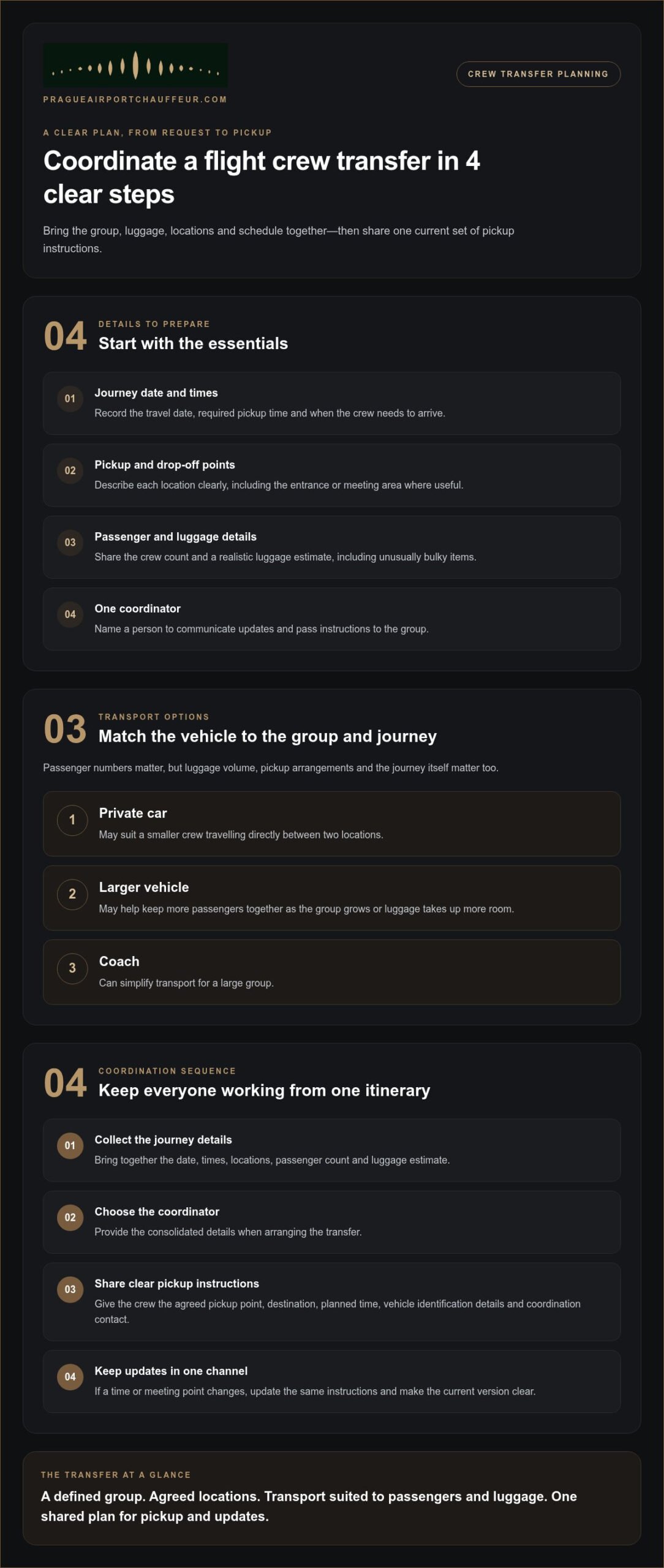
Bring the essential details together before arranging transport. Include:
- Journey date and times: Note the travel date, required pickup time and the time the crew needs to arrive.
- Pickup and drop-off points: Describe each location clearly, including the relevant entrance or meeting area where useful.
- Passenger and luggage details: Give the crew count and a realistic luggage estimate, including any unusually bulky items.
- Coordinator details: Name one person to communicate updates and pass instructions to the group.
Different crew roles can involve distinct work routines, so a little context can help the organizer consider the passenger experience. The U.S. Bureau of Labor Statistics’ Flight Attendant Occupational Outlook outlines flight attendants’ duties and work environment. Use the crew’s actual itinerary and requirements to shape the transfer plan rather than assuming every group has identical needs.
How to keep pickup instructions clear
Once the journey is arranged, send the crew a concise itinerary. State the pickup point, destination, planned time and agreed way to identify the vehicle. Include a coordination contact so passengers know where to direct questions. Keep the message easy to scan, particularly for people reviewing it between duties.
Use one communication channel for changes. If a time or meeting point changes, update the instructions there and make clear which version is current. Avoid sending conflicting details across separate messages. This gives the coordinator, crew and professional driver a shared reference without implying that schedule changes can always be anticipated or accommodated.
Follow a consistent sequence:
- Collect the journey date, times, locations, passenger count and luggage estimate.
- Choose a coordinator and provide the consolidated details when arranging the transfer.
- Share the agreed pickup instructions and contact information with the crew.
- Communicate updates through the same channel and keep the itinerary current.
This approach makes crew transport easier to manage from the initial request through to pickup. To arrange a coordinated journey with professional drivers, explore crew transfer arrangements.
Choose crew transport by group size, luggage, and journey
The right arrangement carries the crew and their luggage comfortably while fitting the itinerary. A private car may suit a small group travelling directly. A larger vehicle can bring more passengers together, while a coach can simplify transport for a large group. Passenger numbers are only one part of the decision: luggage volume, pickup arrangements and the journey itself matter too.
When a private car or larger vehicle may fit
A private car may be a straightforward option for a smaller crew travelling directly between two locations. As the group grows, or luggage takes up more room, a larger vehicle can make it easier to keep everyone on one coordinated journey. Consider passenger numbers alongside the number and size of bags, the route and the comfort the journey calls for. Avoid choosing based on headcount alone.
Private car
Best fit: A smaller group travelling directly.
Coordination: Share one pickup point, destination and agreed schedule.
Trade-off: Passenger numbers or luggage may make this less suitable for a larger group.
Larger vehicle
Best fit: A group or luggage load that needs more room than a private car arrangement.
Coordination: Consolidate passenger and luggage details to plan the journey as one movement.
Trade-off: Base the arrangement on the actual group and bags, not just a rough headcount.
Coach transport
Best fit: Large groups, delegations or coordinated events.
Coordination: Bring pickup, destination and timing together in one group itinerary.
Trade-off: A coach may be more than a smaller crew movement requires.
When coach transport can simplify group movements
For a large crew group, delegation or event, coach transport can bring passengers together under one journey plan. That can reduce the need to coordinate separate vehicles and give the organizer one set of pickup and drop-off details to share. Prague Airport Chauffeur provides large coach transport for different group sizes, with professional drivers supporting planned journeys.
Consider the itinerary as well as the vehicle. If the journey includes a connection between cities, the group airport transport guide may help with the intercity portion. Match the arrangement to the complete journey, then communicate the plan clearly so passengers know where to meet and what to expect.
Plan for schedule changes without adding friction
A change to a flight or crew itinerary can affect the pickup time, meeting point or destination. A simple update process helps the organizer respond without sending mixed instructions. Contingency planning means deciding how information will be shared if plans change. It is not a promise of live flight tracking, automatic schedule adjustments or guaranteed waiting time.
Create a practical update process
Choose one lead coordinator to distribute revised journey details to the relevant passengers. Keep the latest itinerary in one accessible place, with the current pickup time, meeting point and destination clearly stated. If details change, update that reference and share the revised version through the agreed channel. This gives everyone one source to follow.
Agree in advance how the coordinator will communicate updates and who needs to receive them. Keep the process realistic: organizers can share information they receive, but should not assume flight status is being monitored automatically. Clear ownership of updates can reduce uncertainty without overstating what schedule planning can control.
Reduce uncertainty for crew members
Give crew members concise pickup instructions before the journey begins. Include the meeting point, current time, destination and agreed method for identifying the vehicle. If a detail changes, state what is different and which instruction replaces the previous one. Avoid forwarding partial updates that leave passengers unsure whether the time, location or both have changed.
A useful update is brief and factual: “Pickup time updated. Meet at the agreed point at the revised time shown in the current itinerary.” The organizer can adapt the wording to the journey, then send it consistently to affected passengers. Clear instructions help crew focus on the next step instead of reconciling multiple messages.
Before the transfer, review the itinerary and make sure the crew has the same current details as the coordinator. Keep the communication plan proportionate to the journey: one contact, one accessible itinerary and one agreed channel for changes. This supports coordinated pickup and drop-off arrangements while leaving room for operational updates.
For a planned journey supported by professional drivers and coordinated schedules, explore crew transfer services.
Arrange a flight crew transfer with Prague Airport Chauffeur
Once the itinerary and group requirements are clear, arranging a crew transfer becomes more straightforward. Prague Airport Chauffeur provides crew transfers with professional drivers and coordinated schedules. Share the journey details in one focused request so the transport plan reflects the route, passenger count and luggage needs.
What to include in a crew transfer request
Prepare the information the journey depends on before submitting a request. Include:
- Timing: The planned travel date and required pickup time.
- Locations: Clear pickup and drop-off points, such as an airport and crew accommodation.
- Group details: The passenger count and an estimate of luggage volume.
- Coordination: The organizer’s contact details and any relevant instructions for the group.
Keep the request focused on the actual itinerary. For example, if the crew is travelling together from an airport to accommodation, state the route and note any useful pickup guidance. If the journey includes several legs, list each part in order. A complete, coherent request helps align the vehicle arrangement with the group instead of relying on assumptions.
A composed, coordinated journey from pickup to drop-off
Clear information supports a smooth handover. The organizer can share the agreed journey details with passengers, while professional drivers and coordinated schedules help structure the transfer from pickup through to drop-off. Prague Airport Chauffeur’s fleet serves different group sizes, allowing the arrangement to reflect the crew and its luggage rather than relying on a one-size-fits-all assumption.
Before travel, give crew members the final pickup point, destination and relevant instructions in a format they can easily refer to. Keep the coordinator’s contact details available for journey-related communication. These small steps make the plan easier to follow and reduce the need to resolve basic logistics on the day.
A well-prepared request gives the transfer a clear starting point: itinerary, passengers, luggage, and pickup and drop-off details. Arrange a flight crew transfer with Prague Airport Chauffeur and bring those details together in one coordinated plan.
Make the next crew journey easier to coordinate
Reliable crew transport starts with clear planning. Bring the itinerary, passenger count, luggage needs, and pickup and drop-off details together so the arrangement suits the group and its journey. A simple communication plan also gives crew members one clear reference if details change.
Coordinated schedules and transport suited to different group sizes can reduce the organizer’s logistical workload. Prague Airport Chauffeur provides crew transfers with professional drivers, helping connect the planned journey from pickup to drop-off.
When your itinerary is ready, arrange a flight crew transfer with the key journey and group details. A clear plan supports a more comfortable journey for your crew and lets you focus on the operation ahead.
Frequently Asked Questions
What is a flight crew transfer?
A flight crew transfer is planned ground transport that moves crew members between an airport, accommodation or another transport hub. Unlike individual passenger journeys, it is organized around a defined group and its shared itinerary. The coordinator arranges pickup and drop-off details, considers passenger and luggage needs, and gives the crew clear instructions so the journey is easier to follow.
How do you arrange transport for a flight crew?
Start by bringing the journey details together: date, pickup and drop-off points, required times, passenger count and luggage needs. Identify one coordinator to share instructions and updates with the crew. Provide this information as one clear request so the transport arrangement can reflect the actual itinerary and group rather than assumptions.
Can a transfer service accommodate a larger flight crew group?
Yes. Transport can be planned for different group sizes, including large groups. The appropriate arrangement depends on how many crew members are travelling, how much luggage they have and whether they need to travel together. A coach may suit a large coordinated movement, while another vehicle arrangement may better fit a smaller group. Share passenger and luggage details when arranging the journey.
What information should I provide when booking a crew transfer?
Provide the planned travel date, required pickup time, exact pickup and drop-off points, passenger count and an estimate of luggage. Include the coordinator’s contact details and any instructions the crew needs to follow at collection. If the itinerary has several journey legs, list them in order. A focused, complete request helps shape transport around the group’s actual needs.
How should a crew transfer plan handle schedule changes?
Choose one coordinator to share updates, and keep the latest pickup time, meeting point and destination in one accessible itinerary. If details change, update that reference and send revised instructions through the agreed communication channel. Keep messages brief and specific about what has changed. This is contingency planning, not a promise of live flight tracking or guaranteed waiting.
Is a private car or coach better for flight crew transport?
It depends on the group and its luggage. A private car may suit a smaller crew travelling directly, while a coach can simplify transport for a large group or delegation. A larger vehicle may also help when passenger numbers or luggage make a smaller arrangement unsuitable. Compare the itinerary, group size and luggage together, then choose an arrangement that fits the complete journey.
Why use a professional transfer service for flight crew?
A professional transfer service helps organizers bring pickup and drop-off logistics into one planned journey. Prague Airport Chauffeur provides crew transfers with professional drivers, coordinated schedules and transport for different group sizes. Sharing the itinerary, passenger count and luggage needs helps align the arrangement with the crew’s requirements. Clear instructions also make it easier for passengers to understand where to meet and where they are going.


