

Corporate travel planning works best when the journey matches the day’s schedule, passenger numbers, and need for flexibility. A single appointment may call for a point-to-point transfer, while a packed itinerary with several stops can benefit from a chauffeur by the hour.
Cost, convenience, comfort, and timing all matter, especially when colleagues arrive at different times or meetings run to a tight schedule. Public transport, shared shuttles, private transfers, hourly chauffeur service, and coaches each suit different needs. Choose a format that makes every pickup and drop-off clear without adding unnecessary coordination.
This guide compares the main business transport options and explains how to match them to your itinerary, group size, and schedule. You’ll learn when direct travel makes sense, where shared services fit, and how hourly chauffeur and coach journeys can support more complex plans. With a suitable arrangement, your team can travel comfortably and focus on the work ahead.
Key Takeaways
- For business transport Prague, start with the itinerary: count the stops and passengers, and list each pickup point.
- Choose a private transfer for a direct journey, or hourly chauffeur hire when the schedule includes several stops.
- Compare options by flexibility, privacy, passenger capacity, and the coordination each journey requires.
- Share the pickup sequence, luggage needs, passenger numbers, and appointment times when arranging travel.
- Use a shared shuttle or large coach to suit the group’s travel needs and keep logistics organized.
Business transport: start with the itinerary, not the vehicle
Employees, clients, and guests may need to travel between arrivals, meetings, hotels, and other commitments during a busy working day. Choose transport to support the itinerary, rather than letting the vehicle dictate it. First map the journey: how many stops are planned, how many people are travelling, what luggage they have, and when they need to arrive?
Business transport is a journey service matched to work-related travel, with the pickup plan and format shaped around passengers’ schedules and destinations. It may be a direct transfer between two points or a chauffeur service arranged around several appointments. This Business Travel Overview provides more context on work-related travel.
A point-to-point journey is straightforward to plan when passengers share a pickup and destination. A day of successive appointments has different demands: a meeting may run longer, another passenger may need collecting, or the group may visit several destinations in sequence. In those cases, the order of stops and timing matter as much as the vehicle type.
- Stop count: Is there one destination or a sequence of appointments?
- Passenger plan: Will everyone travel together, or are separate pickups needed?
- Luggage and timing: What needs to travel, and which arrival times are fixed?
Which business journeys need dedicated transport?
Dedicated transport can organize airport arrivals, client meetings, hotel transfers, and company journeys between destinations. It is useful when colleagues or guests share a schedule and need coordinated pickups and drop-offs. For several appointments, agree on the stop sequence and include each destination in the plan. One coordinated journey can be simpler to manage than separate travel arrangements.
For example, a visiting client may arrive before a meeting and need a hotel transfer later in the day. A team attending several appointments with equipment or luggage has different requirements. Note each passenger’s part in the itinerary, including where people travel together and where plans diverge. Those details help match the service format to the working day.
When can public transit fit a work trip?
Public transit can suit a straightforward journey when timing is flexible and travellers are comfortable managing the route themselves. It may work for an individual with one destination and no closely timed onward appointment. The trade-off is coordination: transfers, service changes, and separate passenger plans can add steps, particularly when colleagues arrive at different times or carry luggage.
Compare the full journey rather than assuming one option always works better. Consider whether travellers can follow separate routes, whether arrival times can shift, and how much coordination the itinerary requires. A direct transfer can simplify a shared point-to-point plan, while hourly chauffeur hire can better fit a day with several scheduled stops. Choose the option that supports the work commitments with clear logistics and an appropriate level of flexibility.
Business transport options for different schedules and group sizes
The right format depends on how much control the itinerary needs. One pickup and one drop-off call for a different arrangement than a day of appointments or a coordinated group arrival. When comparing business transport Prague options, consider the journey structure, passenger numbers, flexibility, and coordination involved.
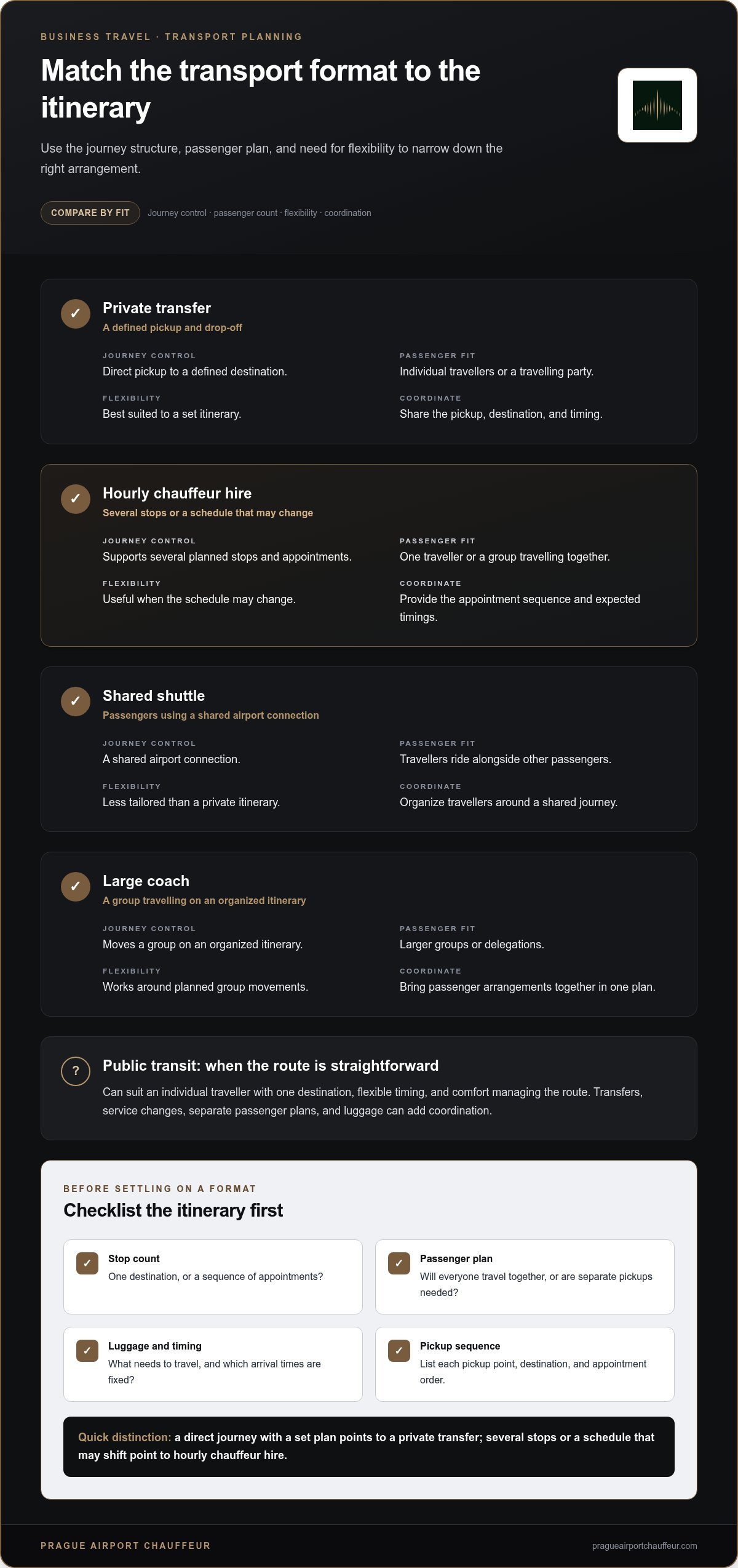
| Service format | Journey control | Passenger count | Flexibility | Coordination needs |
|---|---|---|---|---|
| Private transfer | Direct pickup to a defined drop-off | Individual travellers or a travelling party | Best suited to a set itinerary | Share pickup, destination, and timing |
| Hourly chauffeur hire | Supports several planned stops | One traveller or a group travelling together | Useful when the schedule may change | Provide the appointment sequence and expected timings |
| Shared shuttle | Shared airport connection | Passengers travel alongside others | Less tailored than a private itinerary | Coordinate travellers around a shared journey |
| Large coach | Moves a group on an organized itinerary | Larger groups or delegations | Works around planned group movements | Bring passenger arrangements together in one plan |
Private transfers or hourly chauffeur hire?
Choose a private transfer for a defined point-to-point journey, such as a pickup followed by one destination. It keeps the plan simple when the route and timing are clear. Hourly chauffeur hire is better suited to several meetings, multiple stops, or plans that may shift during the day. Neither format is right for every trip: let the itinerary decide.
A guest travelling directly from an arrival point to a meeting has different needs from an executive visiting several appointments before returning to a hotel. Match the format to the amount of schedule control required rather than choosing by vehicle type alone. Business transfers also support work-related journeys where a clearly arranged pickup and drop-off are central to the plan.
When do shared shuttles or coaches make sense?
A shared shuttle is an option for passengers using a shared airport connection. It suits travellers whose plans work with a shared ride rather than a tailored private itinerary. A large coach moves larger groups together, including delegations and organized company groups. Passenger numbers and whether everyone needs to travel on one coordinated journey help distinguish between the two.
Consider how the group will move: do travellers need separate pickups, a shared connection, or one organized trip together? A shared shuttle and a coach support different coordination needs. Compare the business transport options with your itinerary, passenger plan, and appointment sequence.
What to compare before choosing business transport
A useful comparison looks beyond the vehicle. For business transport Prague, assess how directly the service follows the itinerary, how much flexibility it allows, and whether passengers need a private or shared journey. Then consider passenger capacity, luggage, and the number of stops. These factors can reveal coordination challenges before travel is arranged.
- Directness: Does the journey have one pickup and drop-off, or several destinations?
- Flexibility: Is the schedule fixed, or could meeting times and stop order change?
- Privacy: Do colleagues need a private journey, or does a shared ride suit the plan?
- Capacity and luggage: Can the group and its belongings travel together as intended?
- Coordination: Are passengers sharing one itinerary, or do they need separate pickups and handoffs?
Pay particular attention to passenger handoffs. If a traveller joins the group partway through the day, note the pickup point and timing alongside the main route. Luggage can also affect how easily people move between appointments, especially if they keep it with them throughout the journey. A clear sequence of passengers and stops gives the transport plan a practical shape.
How should companies weigh control against flexibility?
A set transfer is structured around a defined pickup and destination. It suits a journey with a clear plan and no expected additional stops. Hourly chauffeur hire keeps the driver with the itinerary across planned appointments, making it more adaptable when the schedule includes several stops or may change. The less certain the sequence, the more useful it is to plan for flexibility rather than one direct leg.
That doesn’t mean every meeting day requires hourly hire. If appointments are fixed and each leg is arranged as a separate, clearly defined journey, a series of transfers may fit. Consider how likely the plan is to change, how many transitions passengers must manage, and whether retaining the driver across stops would simplify the day.
What matters when several people travel together?
First establish whether passengers share pickup and drop-off points. One coordinated journey can simplify travel for a delegation with the same schedule. Separate transfers may make more sense when people arrive at different times or have different destinations, but they require distinct pickup details and communication. The key question is not just how many people are travelling, but whether the group moves as one.
A shared shuttle suits travellers using a shared airport connection; it is not a private itinerary. A large coach suits organized company travel when a larger group needs to move together. In either case, account for luggage, arrival sequence, and planned handoffs. As a rule, prioritize control when the schedule has several stops or uncertain timings, and capacity when the main need is moving a large group together.
How to plan and book a business transport itinerary
A clear transport plan starts with the full journey, not just the first pickup. If an itinerary involves several travellers or appointments, gather the details in one place before choosing a service format. That gives the organizer a consistent reference for arranging travel, sharing instructions, and handling updates.
Work through these four steps:
- Map the itinerary. List every pickup, destination, and stop in sequence. Include the date and appointment time for each leg.
- Count passengers. Note who is travelling together, who needs a separate pickup, and where the group joins or separates.
- Select the service format. Use a direct transfer for a defined point-to-point journey, hourly chauffeur hire for several stops, or a shared shuttle or coach when the group format fits.
- Share journey details. Provide the full sequence, passenger information, luggage needs, and a contact person for coordination on the day.
What journey information should the organizer prepare?
Gather the practical details before arranging transport: pickup and drop-off points, travel dates, times, passenger numbers, and a contact number for coordination. Record the stop order and any meeting windows that affect the schedule. Include luggage requirements in the journey plan. For group travel, designate one coordinator to relay agreed updates and keep passenger instructions consistent.
Be specific about handoffs. If some travellers join later or leave before the final destination, show where that happens and who is travelling on each leg. This helps distinguish one shared itinerary from several individual journeys and reduces the risk of conflicting pickup instructions.
How can teams keep a travel plan clear?
Once the details are arranged, send each traveller the pickup point, time, and relevant instructions. Keep changes in one agreed communication channel rather than spreading updates across separate messages. The organizer can maintain a current itinerary and relay changes to the affected passengers. For multi-stop plans, hourly chauffeur hire provides a format suited to a schedule that may shift across appointments.
Before travel, compare the shared itinerary with the latest meeting schedule. If an appointment moves, update the central plan first, then communicate the revised instruction to the affected travellers. Avoid relying on informal verbal updates alone. One current source of information makes handoffs clearer for passengers and the person coordinating the journey.
For a coordinated business journey, arrange business transport around the passenger list, stop sequence, and appointment schedule.
Arrange business transport with a service that fits the journey
A well-matched service turns an itinerary into a clear transport plan. Private transfers, hourly chauffeur hire, and business transfers support different kinds of corporate travel. Professional drivers transport individual travellers, corporate clients, and larger groups, while the right service format helps organize how passengers move between commitments.
Use the journey pattern to guide your choice:
- Defined point-to-point journey: A private transfer suits a clear pickup and drop-off, such as travel between an arrival point and a meeting.
- Several planned stops: Hourly chauffeur hire fits a day of appointments when the driver stays with the itinerary.
- Shared airport travel: A shared shuttle suits passengers using a shared airport connection rather than a private itinerary.
- Large group movement: A large coach can bring a delegation or organized company group together for a planned journey.
Match the service format to the business plan
Begin with the sequence of the day. If the route has one defined pickup and destination, a direct transfer keeps the arrangement focused. If meetings involve several stops, hourly chauffeur hire supports travel across the itinerary. A shuttle suits shared airport travel, while a coach helps larger organized groups travel together. Choose according to the journey structure, not a blanket ranking.
Business transfers can also be arranged around work-related journeys where coordinated pickups and drop-offs matter. Before booking, bring together the passenger count, timing, luggage needs, and stop order. Clear details help align the service with the group’s practical requirements and make coordination easier for both the organizer and travellers.
Make the next booking step straightforward
Prepare the itinerary in a format that is easy to follow. Include each pickup and drop-off, the stop order, appointment times, passenger numbers, and relevant luggage requirements. For group travel, name one coordinator to share updates and keep instructions consistent. For longer journeys between destinations, the Intercity Private Transfers: Door-to-Door Travel Guide offers related guidance on that travel format.
With the journey details ready, select the service that matches the schedule: a private transfer for a direct route, hourly chauffeur hire for several stops, or a shared shuttle or coach for the right group arrangement. Keep the plan clear and give every traveller the same pickup information.
Share your passenger numbers, timing, and itinerary requirements to plan your business transport around the journey.
Make the next business journey easier to manage
A thoughtfully arranged journey can do more than connect appointments. It gives colleagues a clear point of reference, reduces uncertainty between commitments, and helps them focus when they arrive. Treat the transport plan as part of the working agenda: keep its details accessible, assign one person to manage updates, and align each movement with the purpose of the trip.
That approach gives business transport Prague planning a practical starting point. Before arranging travel, bring the schedule and passenger requirements together so the journey can be shaped around the day ahead. Clear arrangements help guests travel with greater confidence and make the process easier for the organizer to manage.
When you’re ready to put the plan in motion, Arrange business transport for your next journey. A well-prepared itinerary is a confident first step toward a smoother working day.
Frequently Asked Questions
Can a company arrange transport for employees and clients in one travel plan?
Yes. Employees and clients can be included in one coordinated journey plan, with clear instructions for each person. For example, an organizer can note which guests join at the first pickup and which employees meet the group later. A named travel coordinator can keep the passenger list current and share relevant updates, so everyone knows where to meet without receiving the full itinerary.
How far in advance should a business transport journey be arranged?
Arrange transport once the travel dates, passenger list, and main schedule are reasonably settled. There is no single lead time that suits every itinerary, so avoid relying on a fixed booking cutoff. For an event group or several arrivals, starting early gives the organizer time to gather individual details and align instructions. If plans change, circulate the latest itinerary clearly so travellers aren’t working from an outdated version.
Is a chauffeur service suitable for a day with several business meetings?
Yes. Hourly chauffeur hire can suit a working day with several meetings, particularly when travellers need transport between appointments without arranging a separate journey for each leg. An executive might have a morning presentation, a client visit, and an afternoon discussion at different venues. Share the expected stop sequence and meeting windows so the journey plan reflects the day’s structure and any known timing uncertainty.
Can business transport accommodate passengers with different pickup points?
Different pickup points can be included in the journey plan. Provide each passenger’s name, pickup location, preferred contact details, and the order in which people should join the journey. If the group later travels together, state where that shared leg begins. This gives the organizer and professional driver a clear passenger sequence, while each traveller receives instructions relevant to their pickup.
What information should employees receive before their pickup?
Send each employee the pickup location, planned time, and a concise description of where to meet, such as the agreed entrance or meeting point. Include the coordinator’s contact details and instructions for reporting a change. For a group, tell employees whether to wait for colleagues or follow their individual arrangements. Clear, consistent messages help prevent uncertainty at the start of the journey.
Can a company arrange transport for a group attending a business event?
Yes. Large coach services can support organized company travel for event groups and delegations. A shared airport shuttle is a separate option for passengers using a shared airport connection. The organizer can prepare a passenger list, event schedule, luggage notes, and a group contact person. This helps align transport with the event programme and gives attendees consistent travel instructions.
Does business transport include self-drive car rental?
No. The business transport described here is chauffeur-driven, with professional drivers transporting individuals, corporate clients, and groups. It is not a self-drive car rental arrangement. For employee or guest travel, prepare the passenger details and itinerary for a suitable transfer or chauffeur service. The journey plan should show who is travelling, where they need to be picked up, and how their work schedule is arranged.


