

Planning reliable conference transportation teams can rely on means coordinating several connected guest journeys, not just creating one transport schedule. Staggered arrivals, changing passenger numbers and travel between hotels, venues and evening events all affect the plan. When those details are unclear, even a well-planned programme can become difficult to manage.
It is understandable to want one clear overview, especially when speakers, delegates and larger groups travel on different schedules. A dependable plan connects each journey to the conference programme and gives your team a practical way to respond when timings or passenger numbers change.
This guide explains how to map guest movements, estimate group sizes and match each journey with a suitable transport format. You will see where private transfers, shared airport shuttles, hourly chauffeur service and large coaches can fit into a conference schedule. It also outlines how to coordinate updates, so your team can keep arrivals, venue transfers and group travel organised without losing sight of the event as a whole.
Key Takeaways
- Map each guest journey by origin, destination, passenger group, time window and purpose to connect transport with the conference programme.
- Build your conference transportation Prague plan in stages, using early estimates to shape the approach and final attendee details to refine it.
- Match private transfers, shared shuttles, hourly chauffeur service and large coaches to group size, flexibility and journey type.
- Keep schedule changes manageable with one organiser contact, a shared current schedule and a clear process for notifying affected passengers.
- Bring the movement map, selected transport formats and approved schedule together in one operating plan for event day.
Conference transportation planning starts with mapping every guest movement
The challenge is not simply getting people from one place to another. It’s fitting multiple passenger movements into one event programme, often with different origins, timings and priorities. A dependable conference transportation Prague plan starts by recording each journey before selecting vehicles or setting pickup times.
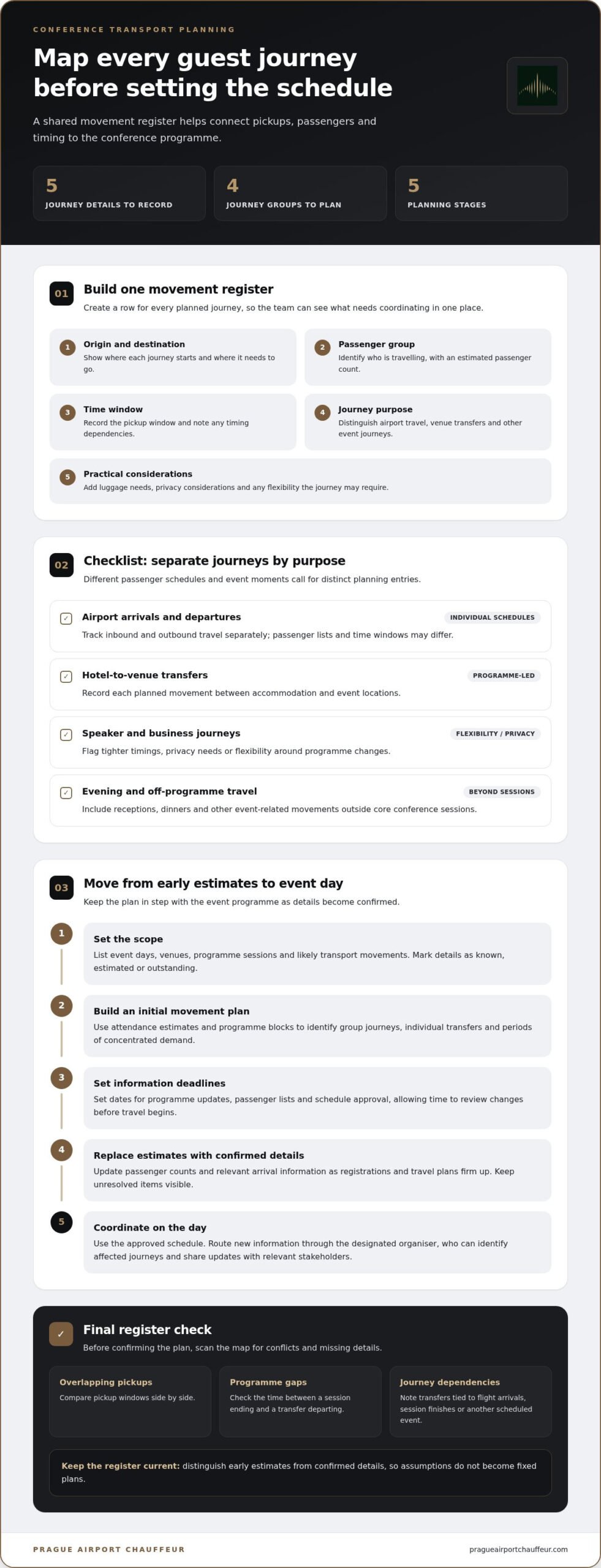
Create one movement map, or register, with a row for every planned journey. Record its origin, destination, passenger group, time window and purpose. Add an estimated passenger count, luggage needs and any timing or privacy considerations. This gives the team a shared view of what must happen, rather than leaving important details in separate emails and programme documents.
Keep the map connected to the wider travel picture. For example, the public transport network provides context for connections delegates may use, while your register captures journeys that need coordinated transfers. The goal is not to document every passenger’s independent choice, but to identify the movements the event team needs to organise.
Which conference journeys need separate planning?
Group journeys by purpose and timing, not just by destination. Airport arrivals and departures follow individual travel schedules; hotel-to-venue shuttles follow the programme. Speakers may need a more flexible or private transfer, while delegates may travel together. Evening functions also need their own movement plan, particularly when they finish outside the core conference schedule.
- Arrival and departure journeys: Track incoming and outgoing travel separately, since each may involve different passenger lists and time windows.
- Venue transfers: Record each scheduled movement between accommodation and event locations.
- Speaker and business journeys: Note tighter timings, privacy needs or flexibility around programme changes.
- Evening and off-programme travel: Include receptions, dinners and other event-related movements beyond conference sessions.
How does a movement map prevent planning blind spots?
A single register lets the team compare movements side by side. That makes it easier to spot overlapping pickup windows, gaps between a session ending and a transfer departing, or passenger estimates that need refinement. Update it as attendee information develops, distinguishing early estimates from final details so assumptions don’t become fixed plans.
- Record the essentials: Add passenger estimates, pickup windows, destinations and luggage considerations for every movement.
- Mark the journey format: Separate shared group trips from individual transfers and flexible business journeys.
- Show dependencies: Note when a transfer relies on a flight arrival, session finish or another scheduled event.
Movement type determines the planning approach: shared journeys need coordinated passenger counts and common pickup windows, while individual or flexible transfers need timings that can accommodate separate schedules. With those distinctions visible, the register becomes a practical tool for spotting schedule conflicts early and shaping transport around the programme.
Conference Transport Planning: Estimate to Event Day
Planning becomes manageable when each decision has an owner and a deadline. For conference transportation Prague, begin with a working scope, then replace assumptions with confirmed passenger details as they become available. Keep the schedule in step with the event programme so it doesn’t fall out of date.
What information should organisers gather first?
Start with the event dates, programme blocks, estimated attendance and the movements already identified. Add accommodation locations and flight details when they’re available and relevant to transfers. Name one organiser as the contact for consolidated updates and decisions to prevent conflicting versions from circulating. Early estimates can guide the initial transport mix, while passenger names, final counts and individual arrival details can be added as attendee information comes in.
- Set the scope. List event days, venues, programme sessions and likely transport movements. Note which details are known, estimated or still outstanding.
- Build an initial movement plan. Use attendance estimates and programme blocks to identify likely group journeys, individual transfers and periods of concentrated demand.
- Set information deadlines. Choose dates for programme updates, passenger lists and schedule approval. Set them in relation to event scale and complexity, allowing time to review changes before travel begins rather than copying another event’s timeline.
- Replace estimates with confirmed details. Update passenger counts and relevant arrival information as registrations and travel plans firm up. Keep unresolved items visible so the team knows which schedule entries may still change.
- Coordinate on the day. Work from the approved schedule and route new information through the designated organiser, who can identify affected journeys and share updates with relevant stakeholders.
How should the transport schedule be finalised?
Turn confirmed movements into a timetable with a pickup window, destination, passenger group and journey purpose for each transfer. Compare it with the latest event programme. If several groups need to leave at the same time, flag the overlap and decide whether movements should be staggered or handled separately. Record the schedule’s approval date and share one current version with the people responsible for event coordination and passenger communications.
Keep a simple change process beside the timetable: record what changed, which journeys are affected, who needs to know and whether the approved schedule has been updated. For wider delegate travel planning, the event transportation support information outlines public transport passes and group mobility support for eligible events.
Once the timetable is taking shape, align the planned journeys with suitable transfer formats. Private airport and business transfers can form part of the event’s transport mix.
Choose conference transport by group size, flexibility and journey type
The right transport format depends on more than the number of people travelling. A group with substantial luggage may need a different arrangement from the same number travelling light, while a fixed venue transfer calls for different timing from a business itinerary that may change. For conference transportation Prague, compare each movement by passenger grouping, schedule flexibility and whether the journey is direct or shared.
When do private transfers, shuttles or hourly chauffeurs fit?
Private transfers suit defined passenger groups travelling point to point on a planned schedule. Shared shuttles can bring together passengers whose movements and timing are compatible. Hourly chauffeur service is useful when a business itinerary includes several stops or may shift, giving the schedule more flexibility than a single fixed transfer.
| Transport option | Passenger grouping | Schedule flexibility | Journey style |
|---|---|---|---|
| Private transfer | An individual or defined group | Planned around agreed journey details | Direct, point-to-point |
| Shared shuttle | Passengers with compatible movements | Follows a shared schedule | Shared ride |
| Hourly chauffeur | Individual business travellers or a small party | Can accommodate a changing itinerary | Flexible journeys across planned stops |
| Large coach | A larger group travelling together | Best aligned with a defined group schedule | Group journey to a shared destination |
Use the comparison as a starting point, not a vehicle assignment. Confirm passenger numbers and luggage needs before settling the arrangement. Headcount alone can hide practical differences: a group arriving with conference materials, for example, has different space needs from a group carrying only personal bags. For delegates making independent journeys, the official public transport fare guidelines can help organisers review ticket options separately from arranged transfers.
When is a large coach the more practical option?
A large coach can suit a larger delegation when passengers share a destination and departure window. Moving together can simplify coordination for a scheduled group transfer or event movement. If people need different pickup times, separate destinations or more individual flexibility, a single coach may be less suitable. Final allocation should reflect confirmed passenger and luggage requirements, as well as the journey itself.
Before choosing, check each movement against three practical questions: Are passengers travelling together? Is the timing fixed or flexible? Do their luggage needs fit the planned arrangement? A mixed programme may call for several formats rather than one vehicle type for every journey. Pairing shared transport for aligned group movements with private or hourly options for distinct business schedules helps match the plan to the people and purpose of each trip.
Coordinate conference pickups, schedule changes and event-day communication
On event day, a small update can affect several journeys. A delayed arrival may change a pickup group; a programme shift can move a venue departure into the same window as another transfer. For conference transportation Prague, keep decisions orderly with one organiser contact, one shared current schedule and a clear route for communicating changes. Don’t let separate messages become competing versions of the plan.
Before travel begins, agree who can approve a change, who updates the schedule and who informs passengers. This keeps routine updates moving while ensuring decisions with wider consequences reach the right person.
How can organisers keep pickup information clear?
Use the same pickup label, time window and passenger-group name in the schedule, event materials and guest messages. For example, avoid describing one transfer as “morning shuttle” in one place and “venue bus” in another. Give each group concise instructions that match the approved schedule, including where to go, when to be ready and which journey they’re taking.
- Use consistent labels: Keep group and journey names identical across the schedule and communications.
- State the time window: Make clear when passengers should be ready, not just the planned departure time.
- Choose one update channel: Share the current schedule and changes through an agreed channel so guests and event staff don’t rely on outdated copies.
What should the change-management plan cover?
Log each change before acting on it. Record what has changed, when it was received, the journeys affected and who must approve or communicate the update. Then prioritise it by departure time, passenger impact and connection to event sessions. A change affecting the next pickup needs prompt attention; a later adjustment can be reviewed against the programme before the schedule is revised.
- Receive and record: The organiser contact notes the update and its source in the shared schedule.
- Check the impact: Identify affected passenger groups, pickup windows, destinations and connected sessions.
- Approve the response: The designated decision-maker determines whether the schedule or passenger instructions need to change.
- Notify and update: Send the revised information to affected guests and relevant event staff, then mark the shared schedule as current.
Set decision points in advance for delayed arrivals, programme shifts and unexpected demand. For example, define when a late passenger can join a later shared movement and when the organiser should review a separate transfer arrangement. Keep the response within the confirmed transport plan; don’t assume that vehicles can be automatically redirected or held in reserve. Clear roles and concise updates help the team respond without creating confusion.
A coordinated transport plan can reflect your event’s passenger movements and schedule. See the conference transport service for details.
Put the conference transport plan into practice with the right service mix
A working transport plan brings three elements together: the movement map, the selected service formats and the approved event schedule. For conference transportation Prague, this joined-up view helps organisers assign a suitable option to each journey, rather than treating every passenger movement alike. It also gives event staff and professional drivers a shared reference for the planned groups, destinations and timings.
How can one transport partner support different conference movements?
Conference programmes often combine journeys with distinct requirements. Private airport transfers can serve defined passenger groups arriving at different times, while hotel, business and event-related transfers connect guests with their accommodation and programme. Shared shuttles suit passenger movements with compatible destinations and timing. Hourly chauffeur service can support a business itinerary that includes several stops or may change during the day. Large coach services offer an option for larger groups travelling together when the schedule and destination align.
Professional drivers serve individuals, corporate clients and groups across these transport formats. A service mix can be planned around the event’s actual movement patterns: for example, private transfers for specific arrivals, a shared shuttle for a common group journey, and hourly chauffeur hire for a flexible business schedule. Coach services can be considered for larger delegations without assuming a particular vehicle capacity.
Keep each arrangement tied to a defined journey in the operating plan. Include its passenger group, pickup details, destination, timing and the relevant service format. This makes it easier for the organiser to see where separate movements have different needs and where several passengers can travel together. It also supports clear coordination if the approved event schedule changes.
What should organisers prepare before arranging service?
Bring a concise planning brief that reflects the latest event information. It should give the transport team a practical view of the programme and distinguish confirmed details from estimates, so early assumptions aren’t mistaken for final instructions.
- Event outline: Share event dates, programme timing and the locations involved in planned journeys.
- Passenger groups: Provide estimated group sizes, then update them as attendee information is confirmed.
- Movement types: Identify airport, hotel, business, venue and evening journeys, along with any shared movements or flexible itineraries.
- Pickup details: Supply confirmed pickup points, time windows, destinations and relevant luggage information.
- Update process: Name the organiser contact and use the agreed schedule and communication process to distribute revisions.
For delegations adding longer journeys to the conference programme, the intercity private transfers guide offers a starting point for considering door-to-door travel.
With the movements and schedule in view, discuss your conference passenger groups and timing to shape a transport plan that fits the event.
Move from planning to a well-coordinated event
A clear transport brief gives your team a practical next step: turn the approved programme and passenger movements into arrangements that fit the event. Keep the focus on the journeys that matter most, and leave room to refine details as attendee information becomes clearer. This gives organisers a steady basis for decisions without adding complexity for guests.
For conference transportation Prague, professional drivers can support corporate clients and event groups with private transfers, shared shuttles, hourly chauffeur service and large coaches for different types of journeys.
Explore the transport options for your conference and share your event schedule and passenger movements to start shaping a coordinated plan. Explore conference transport options.
Frequently Asked Questions
How far in advance should conference transportation be planned?
Begin planning as soon as event dates, venues and the main programme are known. The right lead time depends on event scale, the number of separate journeys and how quickly attendee details become available. For conference transportation Prague, set internal deadlines based on those factors rather than relying on a fixed rule. Early planning gives your team time to compare movement needs; later reviews can refine passenger details and pickup instructions.
What information does an organiser need to arrange conference transportation?
Prepare the event dates, venue locations, programme schedule and estimated passenger numbers. For airport journeys, collect relevant arrival or departure details and note which guests should travel together. Also consider luggage, accessibility needs and a contact method for each group, so instructions reach the right passengers. Distinguish confirmed information from estimates. That simple distinction helps prevent provisional counts or timings from being treated as final arrangements.
How do you choose between a shuttle, private transfer and coach?
Choose according to how passengers travel, not just how many are attending. A shuttle suits people with compatible routes and timing; a private transfer fits a defined group with a direct journey; a coach can bring a larger delegation to a shared destination. Consider whether guests have different arrival times, luggage needs or privacy expectations. If those needs vary, separate arrangements may be more practical than placing everyone in one group journey.
Can conference transportation accommodate last-minute schedule changes?
Changes can be managed more clearly when there’s an agreed process, but a new request doesn’t automatically mean every transport arrangement can change. Have one organiser review the impact, record the revised details and communicate the update to affected passengers. Prioritise changes tied to imminent departures or important programme connections. Keep the approved schedule current and align any revised journey with the transport arrangements in place.
How should organisers coordinate airport arrivals for conference attendees?
Collect arrival information as it becomes available, then group guests only when their timing, destination and travel preferences align. Give each passenger a clear instruction for their planned transfer, including the agreed meeting point and the organiser’s contact method. Keep departures and arrivals as separate lists, since guests leaving the event may have different timing needs. Avoid assuming that everyone arriving around the same time should share one vehicle.
Is hourly chauffeur service suitable for a conference speaker’s itinerary?
Yes, hourly chauffeur service can suit a speaker’s itinerary when it includes several appointments or may shift during the day. It offers a flexible alternative to arranging a separate point-to-point transfer for every stop. Share the planned sequence, approximate timings and any known programme constraints when arranging the journey. If the itinerary changes, route updates through the event contact so the speaker and organiser work from the same information.
What is the best way to manage transport for a large conference group?
Divide the group into practical travel streams instead of treating all attendees as one booking. Separate guests by arrival period, destination, programme role or luggage needs, then assign transport according to each group’s requirements. Appoint a coordinator to manage passenger information and keep instructions consistent. For large events, review the group plan alongside registration updates so changes in attendance can be reflected before they create confusion at pickup points.


