

The cheapest or fastest option isn’t always the one that feels simplest. A long-distance private car can make the journey more straightforward when your priority is a planned pickup, a direct trip, and keeping your party together, rather than fitting around station connections or fixed departure times. The key is knowing how the arrangements work before you book.
It’s reasonable to compare a private transfer with trains, buses, and shared rides. Public transport may suit travelers focused on fare or schedule; a private journey can be a practical fit when you’re coordinating several passengers, luggage, and a specific departure plan. Professional drivers handle the drive, while pickup and drop-off details are arranged around your itinerary.
This guide explains what door-to-door travel involves, how the options differ, and which details help shape a smooth booking. You’ll learn what to share about passenger numbers, luggage, pickup and drop-off points, and timing, so you can choose with greater confidence and know what to expect from the journey.
Key Takeaways
- Choose a transfer based on your priorities, such as direct pickup, shared travel, or schedule flexibility, not prestige.
- A Prague to Vienna private car can simplify coordination when passengers are traveling together with luggage.
- Compare private travel, trains, and shared transport by privacy, pickup convenience, connections, and flexibility.
- Prepare passenger numbers, luggage details, pickup and drop-off points, and preferred timing to help plan the journey.
- Learn how professional drivers and a tailored itinerary can make the booking process clearer and the trip easier to organize.
When Does a Private Intercity Car Transfer Make Sense?
The right way to travel depends on your priorities, not prestige. A train or shared service may suit you if you’re comfortable following a set timetable and reaching a departure point. A private transfer can be a practical alternative when you value a planned pickup, a direct journey, and privacy along the way. For a Prague to Vienna private car, the decision often comes down to how much coordination you want to manage yourself.
A private intercity transfer is a pre-arranged car journey that picks you up at an agreed point and takes you directly to your chosen destination. Instead of organizing separate trips to and from stations, you travel in one dedicated vehicle. That can make the journey easier to coordinate, though it won’t be the best fit for every budget, schedule, or travel style.
Consider the shape of your day, not just the distance. If you’re carrying several bags, traveling with children, or bringing colleagues together, direct pickup and drop-off can remove extra handovers. You also have more control over your departure timing than you would with fixed public transport schedules. Shared transport, by contrast, may involve other passengers and a structure that doesn’t revolve around your party’s itinerary.
Which travelers benefit most from a private car?
Families, small groups, business travelers, and passengers with tight schedules may appreciate having one journey arranged around their party. A dedicated vehicle keeps companions together and makes it simpler to coordinate luggage, pickup, and arrival. For business travel, a planned transfer can also reduce the number of separate arrangements to manage. If you’re traveling alone with light luggage and can work around a public timetable, another option may suit you just as well.
Think through the practical trade-off: a private trip offers privacy and more control over pickup, while a train or shared service follows its own timetable and may require you to reach a station or meeting point. The best choice is the one that fits your passengers, bags, and preferred pace.
What does door-to-door travel mean in practice?
Door-to-door means the pickup and destination are arranged around your itinerary. You provide the relevant addresses or meeting points in advance, along with passenger and luggage details. Clear information helps coordinate the handover, so everyone knows where to meet and where the journey ends. The service is a direct transfer between those points, rather than a sightseeing tour with planned visits or hourly chauffeur hire that reserves a driver for a set period.
Before deciding, picture the full trip from the moment you leave to your final arrival. If station access, several bags, or keeping companions together would add friction, a direct transfer may simplify the plan. If fixed departures and shared travel work comfortably for you, compare those options on the same basis. The aim is a clear, manageable itinerary, not choosing the most elaborate mode of transport.
How a Private Intercity Car Journey Works
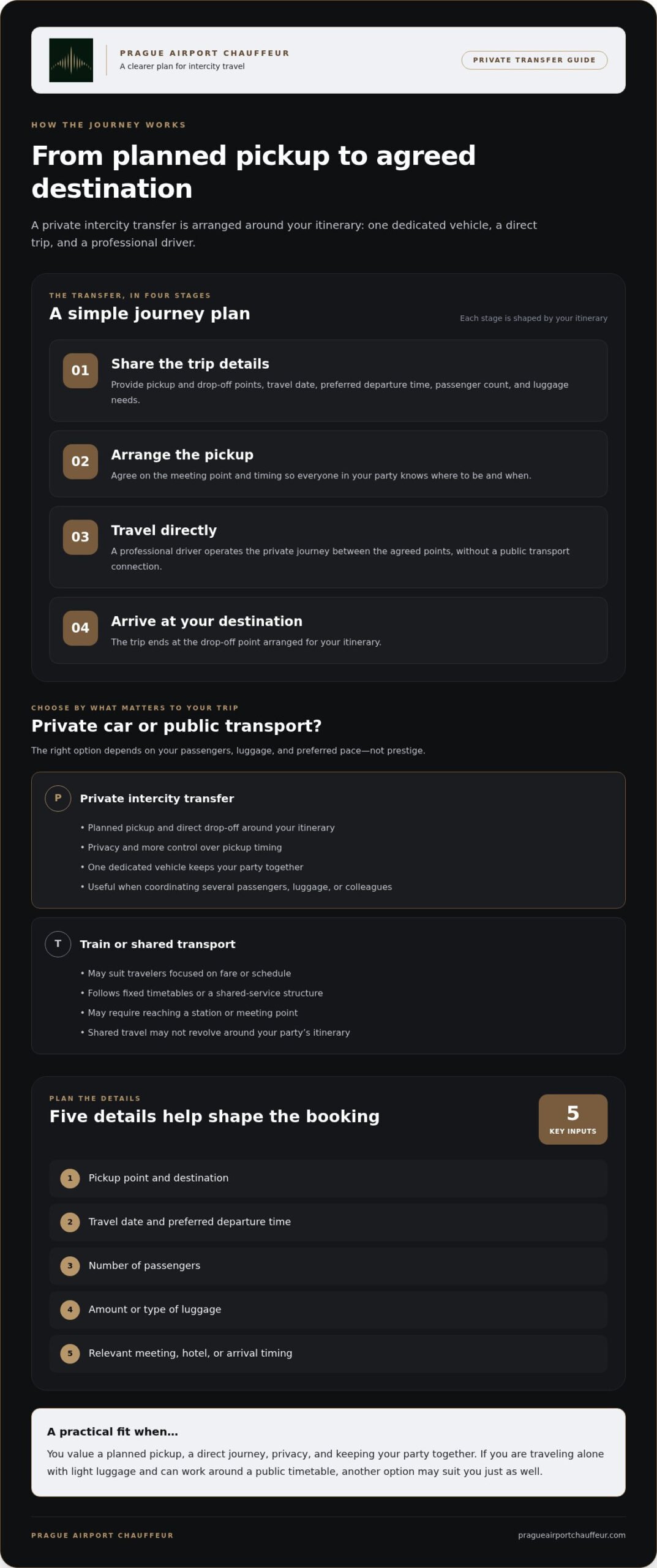
A smooth transfer starts with a clear plan. You share the journey details, agree on a pickup arrangement, travel directly with a professional driver, and arrive at the destination you’ve chosen. The service is a private intercity transfer; the exact pickup point, timing, passenger count, and drop-off details are shaped around your itinerary.
Share your itinerary, arrange the pickup, travel with a professional driver, and arrive at your agreed destination. Each step is simple, but accurate information at the start helps keep the arrangements clear for everyone traveling.
- Share the trip details. Provide the pickup and drop-off points, travel date, preferred departure time, passenger count, and luggage needs.
- Arrange the pickup. Set out the meeting point and timing so your party knows where to be and when.
- Travel directly. A professional driver operates the private journey between the agreed points, without a public transport connection.
- Arrive at the destination. The journey ends at the drop-off point arranged for your itinerary.
What information helps arrange the transfer?
Prepare the full pickup and destination details, travel date, and preferred departure time. Include how many passengers are traveling and the amount or type of luggage, so the journey can be planned around your party. If you’re coordinating a business meeting or hotel schedule, share the relevant timing and destination requirements as part of the itinerary. Clear details help align the pickup and arrival plan without assuming every trip has the same needs.
Some elements are part of the service: private intercity travel, a direct connection between the agreed points, and a professional driver. Other details are specific to your booking, including the pickup time, exact meeting point, passenger information, and destination. Keeping that distinction clear helps you understand what the service does and what your own itinerary needs to specify.
What should passengers expect on the day?
Before departure, make sure everyone in your party has the agreed pickup point and timing. Keep the destination details accessible, especially if another person is coordinating the booking. This simple preparation can prevent confusion at the handover. Once the journey begins, a professional driver handles the driving while your party travels together toward the planned destination. No particular vehicle features, waiting terms, or journey duration should be assumed unless they’re part of the trip arrangements.
If you’re planning activities around arrival, use official tourism guidance for general destination information, then set your pickup and departure plan around your own schedule. For a direct journey arranged around your itinerary, explore private intercity transfer arrangements and prepare the details that will help coordinate your trip.
Private Car vs Train or Shared Transport: How to Compare
Compare each option against the way you actually plan to travel. A private car can suit passengers who value a coordinated pickup, privacy, and a direct journey. Trains and shared transport may work well if their timetables and departure points fit your plans. Neither is automatically the better choice; the practical difference lies in how much control you want over the journey and how much connection planning you’re comfortable handling.
| Consideration | Private car | Train | Shared transport |
|---|---|---|---|
| Privacy | Travel with your own party. | Share the carriage with other passengers. | Travel alongside other passengers. |
| Pickup convenience | Pickup is arranged at an agreed point. | Begin at a station, then plan onward transport. | Use the service’s arranged pickup or departure point. |
| Schedule flexibility | Agree a departure time around your itinerary. | Choose from scheduled departures. | Fit your plans around the service schedule. |
| Connections | Direct travel between agreed points. | Station access and local transport may require planning. | Follow the shared route and its arrangements. |
When is a private car more convenient than a train?
A private car may simplify the journey if getting to a station and arranging onward transport would add steps. This can matter when several companions are traveling together, or when luggage makes multiple handovers awkward. Your party can coordinate around one pickup and one destination instead of organizing separate station transfers. That convenience is practical, not universal: travelers comfortable with station access and fixed departures may prefer the train.
Consider the complete itinerary, not only the main leg. A train timetable may provide a clear structure, while station access and onward travel still need to fit around it. With private transport, the pickup and drop-off points are arranged for the trip, giving you more say in the departure plan. Compare the arrangements that matter to you rather than assuming one option will be faster, cheaper, or more reliable.
When might shared transport be a better fit?
Shared transport can suit travelers whose timing and pickup arrangements align with a scheduled service. It may mean fewer individual travel arrangements to make, while offering less control over the journey than a dedicated car. If you’re comfortable sharing the ride and following its planned schedule, that trade-off may be worthwhile. If privacy, a coordinated pickup, or keeping your party together matters more, private intercity travel may fit better.
For a balanced decision, list your priorities in order: pickup simplicity, privacy, flexibility, or comfort with connections. Then compare each mode against the same list. A private intercity transfer is designed around a direct, arranged journey; public and shared options follow their own schedules and departure structures. The Prague to Vienna private car search is only a starting point. Your passenger needs and itinerary should guide the final choice.
Plan the Journey Around Passengers, Luggage, and Timing
A well-planned transfer begins with the details that shape your day. Passenger numbers, luggage, pickup location, and preferred departure time help create an itinerary that fits the people traveling, not just the route. Share your priorities early, including any child-related or accessibility considerations, so they can inform the arrangements. Mentioning a need doesn’t imply that particular equipment is included; it gives the journey planning a clear starting point.
Use this checklist before arranging your trip:
- Passengers: Give the accurate number of people traveling, including children.
- Luggage: Describe the amount and type of bags realistically, including bulky items.
- Pickup and drop-off: Provide clear addresses or meeting points for both ends of the journey.
- Timing: Share your preferred departure time and any arrival commitments that shape the plan.
- Special considerations: Note child-related, accessibility, or other practical needs in advance.
Clear priorities help tailor a private transfer to the itinerary. For example, a business appointment may make the arrival plan central, while a family trip may call for extra attention to how passengers and bags are organized. The intercity private transfers guide offers more context on planning a direct journey around your pickup and destination.
How should you prepare passenger and luggage details?
Be precise rather than estimating loosely. Count every passenger and describe luggage in terms that make sense, such as several suitcases plus smaller personal bags, or one large item that needs particular consideration. These details help coordinate a suitable travel arrangement without assuming a vehicle capacity or baggage limit. If your group changes, update the itinerary details so the plan reflects who and what will actually travel.
How can you make departure and arrival smoother?
Choose a specific pickup point that everyone can identify, then agree on a practical departure window. If you’re leaving from a hotel or coordinating a business schedule, account for the time needed to gather your party and belongings. Build reasonable contingency into plans around important commitments, rather than relying on an assumed journey duration. Share the intended drop-off point clearly, too, so the arrival plan is just as straightforward as the pickup.
Before the day, make sure each traveler has the same pickup details and timing. One shared plan can prevent last-minute confusion, especially when someone else is organizing the booking. Once your passenger, luggage, and timing needs are clear, you can plan a private intercity journey around your itinerary.
Book a Private Intercity Car with Confidence
Booking becomes clearer when you can describe the journey in practical terms. A private intercity transfer is arranged around your itinerary, with professional drivers handling the drive and pickup and drop-off details planned for your trip. Before you proceed, make sure the journey summary reflects the people traveling, the luggage they’ll bring, and the timing that matters to them.
Use this short checklist to gather the essentials:
- Travel date and preferred departure time, including any timing constraints.
- Pickup and drop-off points, with clear addresses or meeting locations.
- Passenger count, including every traveler in your party.
- Luggage details, described realistically, including any bulky items.
- Relevant itinerary needs, such as a hotel schedule, business commitment, or child-related consideration.
What should you have ready before booking?
Bring these details together before entering your booking information. Clear addresses help define where the journey begins and ends; an accurate passenger count and luggage description help shape the travel arrangement. If an appointment or hotel schedule affects your preferred departure, include that context so the itinerary can be planned around it. For a Prague to Vienna private car, organized trip details make it easier to review whether the proposed arrangement matches your plans.
Review the journey information carefully before completing the booking. Check that the date, pickup point, destination, passenger count, and timing reflect your current plan. Read the fare and booking terms as presented, so you understand the quoted amount and the conditions attached to your particular booking. Don’t assume that optional services or extras are included unless the booking details say so.
Why choose a dedicated private transfer?
A dedicated transfer is a practical choice when privacy, direct travel, and coordination matter to your party. Instead of arranging separate connections, you travel together between the agreed points. Professional drivers operate the journey, while the itinerary is tailored to the passenger’s plans. This approach can work for individual travelers and corporate passengers alike, without suggesting that it suits every schedule or travel priority.
Before confirming, take one final moment to compare the planned pickup and destination with your day’s commitments. A clear itinerary gives the journey a calm, predictable structure, while accurate passenger and luggage details help prevent avoidable confusion. If your arrangements change, keep your trip information consistent with the updated plan.
With your date, locations, passenger count, luggage, and timing ready, you can move from comparing options to arranging the journey. Arrange your private transfer around the itinerary you’ve prepared.
Set Your Journey in Motion with a Clear Plan
The best next step is to turn your travel priorities into a simple itinerary. Decide what matters most, whether that’s keeping your party together, choosing a pickup that fits your day, or having a direct journey without public transport connections. With those preferences in view, a Prague to Vienna private car becomes easier to assess as part of your wider travel plans.
Before arranging the transfer, take a moment to align the details with everyone traveling. A shared understanding of the pickup, timing, and destination can make the day feel more settled before it begins. Then choose the travel arrangement that suits your plans, without adding complexity you don’t need.
For individual travelers and corporate passengers alike, a private intercity transfer offers a considered way to plan direct travel with professional driving and an itinerary shaped around the trip. Arrange your private intercity transfer and take the next step with a clear plan in place.
Frequently Asked Questions
Is a private car transfer worth choosing over public transport?
It can be worth choosing if your priorities are privacy, a coordinated pickup, and traveling directly to your destination. Public transport may suit you better if you’re happy to follow scheduled departures and organize your own access to stations and onward travel. Compare the whole trip, including getting to the departure point and managing your belongings, rather than judging by the main journey alone.
How does a private intercity car transfer work?
You provide your journey details, including where you want to be picked up and dropped off, then travel between those agreed points with a professional driver. Keep the itinerary available to everyone in your party so they can follow the same plan. If your arrangements change before departure, update the trip details promptly to keep the pickup and destination information aligned.
Can I book a private car for a business journey?
Yes. Private intercity transfers support corporate as well as individual travel. They can be useful when colleagues need to travel together or when the journey must fit around a meeting schedule. For example, if a meeting ends at a different address from the original drop-off point, include that in the itinerary planning. A clear plan helps the journey work alongside the business day.
What information should I provide when booking a private car?
Provide the travel date, pickup and drop-off details, passenger count, luggage information, and preferred departure time. Include any timing commitments that shape the itinerary, such as a meeting or hotel check-in. If the pickup point has more than one possible entrance, describe the intended meeting place clearly. This helps everyone understand the plan and reduces uncertainty on the day.
Can a private car transfer accommodate luggage?
You can travel with luggage, but share an accurate description when arranging the transfer so the journey can be planned around your party’s needs. Mention the number and type of bags, including bulky items such as a folded stroller or sports equipment. Don’t assume every arrangement suits every load. Clear details help avoid surprises and support a more considered travel plan.
Is a private car transfer the same as a sightseeing tour?
No. A private intercity transfer is arranged to take passengers directly between agreed pickup and drop-off points. A sightseeing itinerary is organized around visits or multiple planned stops. If you want a driver for a schedule that includes several activities, an hourly chauffeur service is a different arrangement to consider. State your intended purpose clearly so the service matches the day you have planned.
How can I make a private car journey more comfortable?
Prepare for your own needs before departure. Keep important personal items, medication, travel documents, and anything you may need during the ride easy to reach, rather than packed away with larger bags. Agree on the pickup details with your companions and allow time to gather everyone before leaving. A calm start and a shared plan can make the journey feel more settled.


