

When comparing a private transfer instead of train, travelers should look beyond the time shown on a ticket. Getting to the station, handling bags, changing connections and completing the final leg all affect the journey. A train may be the quicker part of the trip without making it the quickest way to reach your destination.
Rail can be practical when its departure and arrival stations fit your plans, and advance booking may offer lower fares. A private intercity transfer takes you directly between agreed pickup and drop-off points. That can simplify travel when you have several bags, a tight itinerary or a group that wants to travel together. Neither option is automatically better. The right fit depends on the full journey.
This guide compares door-to-door timing, luggage, connections and total cost. It also explains what to prepare when arranging a private transfer with Prague Airport Chauffeur, including pickup and drop-off details, passenger numbers and luggage needs. Use these factors to choose the option that works for your itinerary from start to finish.
Key Takeaways
- Compare the full trip from your starting point to your final destination, including every connection and onward leg.
- Weigh a private transfer’s direct travel and flexible pickup against rail’s published departure times.
- Consider luggage and group coordination when deciding which option will make the journey simpler.
- Compare the total journey cost, not just the train fare or the road journey.
- Before arranging a private intercity transfer, prepare your pickup and drop-off details, passenger count and luggage needs.
Private transfer or train: compare the complete journey, not one leg
A private transfer is pre-arranged, driver-operated travel between agreed pickup and drop-off points. Train travel follows a published schedule between stations, so you may need separate transport to reach the departure station and continue from the arrival station. The difference is more than private versus public transport: it affects how you arrange each stage of the trip. For a foundational definition, see private transport.
To compare the options fairly, start at your actual origin and finish at your actual destination. A train’s advertised duration covers the rail leg, not necessarily the trip to the station, time spent waiting, any connection or the final onward journey. A private transfer connects the agreed pickup and drop-off points directly, without public-transit connections between them.
Neither option is universally better. A suitable train schedule can make rail straightforward, while direct road travel can reduce the number of stages to manage. When weighing a private transfer instead of train Prague travelers should compare the complete itinerary, rather than assume the fastest-looking main leg will be easiest overall.
What counts as door-to-door travel?
Separate the main transport leg from the steps around it. For rail, account for getting to the station, arriving in time to board, waiting, changing trains if needed, and travelling from the final station to your destination. For a private transfer, consider the agreed pickup and drop-off points and any preparation needed before departure. Carrying bags through stations or between connections can add effort, especially when travelling with others.
Why journey time is more than minutes in transit
A train’s scheduled time is useful, but it does not include every part of your travel day. Road time is also an estimate: traffic and other journey conditions can affect the drive. Compare the full timeline, including arrival buffers and onward travel, rather than treating either mode’s in-transit duration as the total. Check current rail schedules and route-specific journey times before making plans, since services and timings can change.
For a clear comparison, write down each stage from your starting point to your final stop. Note where you will wait, change transport and handle luggage. This makes it easier to see whether a scheduled rail journey or a direct private transfer fits your itinerary with less friction.
How private transfers and train journeys differ in practice
The practical difference is how each mode organizes the trip. Rail works to a timetable and follows a set network. A private transfer is arranged between agreed locations, with a professional driver taking your party directly between them. The better fit depends on the route, departure time, luggage and how much coordination you want to manage.
Routing: Trains follow rail lines and serve stations. A private transfer travels by road between the agreed pickup and drop-off points.
Schedule: Rail departures are published, making it easier to plan around a known service. A transfer is arranged for your itinerary, though road conditions can affect the journey.
Connections: Rail may involve separate travel to and from stations, as well as changes between services. A direct transfer can avoid public-transport connections between pickup and drop-off.
Luggage: Train passengers manage their belongings through stations and any changes. On a private transfer, your luggage stays with your party during the road journey.
Privacy and group coordination: Rail is shared with other passengers. A private transfer lets your group travel together in one arranged journey, simplifying coordination.
What train travel can make easier
A published departure and arrival time gives rail travelers a clear framework for planning, and there is no need to arrange a driver. This can suit an itinerary that aligns neatly with the station and service schedule. Include the trip to the departure station and onward travel from the arrival station in your plan. Timetables and service details can change, so review current information before travelling.
What a private transfer can make easier
A driver-operated transfer connects agreed locations directly. For families or groups, travelling together can make it easier to coordinate departure and keep luggage organized, rather than managing separate station legs. Direct travel does not remove the effect of road conditions: traffic and other factors can influence journey time, so a road journey is not automatically more predictable than rail.
Transport statistics need context. The Bureau of Transportation Statistics publishes data that may not reflect the conditions of your specific route. For your decision, compare the itinerary and current schedules rather than relying on general assumptions. If direct point-to-point travel suits your plans, explore private intercity transfers.
Is a private transfer faster or worth it instead of the train?
A private car is not automatically faster than a train. Rail can cover the main leg efficiently, while a road journey may avoid station access, connections and separate onward travel. Which option gets you to your final destination sooner depends on the route, departure time, current timetable and road conditions. Compare the whole itinerary, not just the time spent on the train or in the car.
For a fair assessment, map the journey for everyone travelling. Include the trip to the station, waiting time, any changes and transport from the arrival station. Then compare those stages with a direct transfer between agreed pickup and drop-off points. Factors that influence travel choices can extend beyond speed. Consider what matters to your party, such as fewer handoffs, a fixed departure time or less coordination.
When train travel may suit the itinerary
Rail may be a natural fit when your starting point and destination are convenient to stations and a scheduled service matches your plans. It can also suit travelers who are comfortable arranging station access, following departure times and managing any connections. Check the timetable and service details for your exact travel date. A schedule that works on one day may not suit another.
When a private transfer may be worth considering
A private transfer may suit you when direct travel between agreed locations matters more than following a rail timetable. It keeps your party and luggage together during the road journey, reducing the coordination involved in separate station legs. That convenience can be useful for families, colleagues or groups with a shared itinerary. Traffic and other road conditions can still affect journey duration, so allow for uncertainty in your plans.
To weigh value, look beyond the fare or the apparent speed of the main leg. Consider everyone’s onward travel, luggage handling and the effort involved in coordinating each stage. A private transfer instead of train Prague travelers consider may make sense when a direct journey simplifies the itinerary, even if the train’s scheduled leg looks shorter. Rail may suit you better when station access is easy and its timetable aligns well.
There is no universal winner. Compare the exact origin and destination, current rail timings, road conditions and the needs of everyone travelling. Then choose the option that makes the complete journey more practical for your plans.
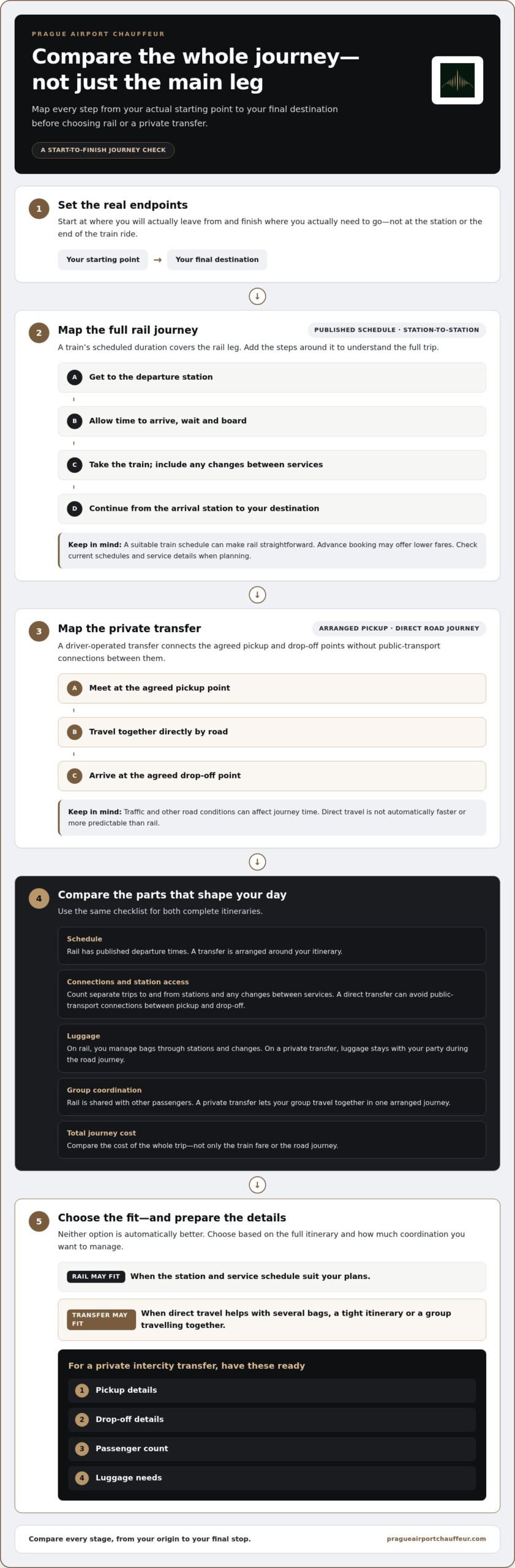
Use this checklist to choose between a train and private transfer
Make the decision from the endpoints inward. Start with the places you need to reach, then account for the people, luggage and timing involved. Work through these five questions before choosing rail or a private transfer.
- 1. Where does the journey begin and end? Write down your actual starting point and destination, not just the stations or main route. Include the time and effort needed to reach a station and continue from the other end.
- 2. Which travel stages will you need? List station access, waiting, train changes and onward transport. Compare them with a direct road journey between your agreed pickup and drop-off points.
- 3. How fixed is your schedule? Decide whether a published departure suits your plans or whether you need a journey arranged around your preferred pickup and arrival times. Check current rail schedules for your travel date.
- 4. How much luggage are you taking? Consider how you will manage bags while getting to the station, changing services and making the final connection. A direct transfer keeps your party and belongings together during the road journey.
- 5. Who is travelling? Note the number of passengers and whether everyone needs to follow the same itinerary. Keeping a family or group together may make a private transfer simpler to coordinate.
Before deciding, check current road conditions as well as rail timetables. A train schedule can change, and road travel time can be affected by conditions along the way. Choose the option that fits your complete itinerary, rather than assuming one mode is always quicker or easier.
Details to prepare for a private transfer
If a direct journey suits your plans, prepare the practical details clearly. Provide the pickup and drop-off points, travel date and preferred departure time. Include passenger numbers and luggage needs so the transfer can be planned around your party. Clear information helps align the arrangement with your itinerary.
Before travelling, review the details you have arranged and keep the trip information accessible. Make sure the pickup and destination points are clear to everyone travelling, especially if one person is coordinating for a group. This simple step can make departure more straightforward.
If direct point-to-point travel is the better fit, arrange a private intercity transfer with your journey details ready. It can be a practical alternative when a schedule-led rail trip would involve extra stages.
Arrange a private intercity transfer when direct travel fits best
The comparison comes down to how well each option fits your complete itinerary. Choose rail when a suitable scheduled service connects conveniently with your start and end points. Consider road travel when you want direct transport between agreed locations and prefer to keep your party together along the way. Neither choice is automatically faster or more suitable. Let the details of your journey guide the decision.
For travelers weighing a private transfer instead of train Prague option, the useful question is whether point-to-point travel makes the overall plan simpler. We provide private intercity transfers with professional drivers for individuals, corporate travelers and larger groups. The service connects agreed pickup and drop-off points directly, without public-transit connections between them.
What a private intercity journey is designed to provide
A private intercity transfer brings the journey into one coordinated road trip. You agree where the driver will collect and drop off your party, then travel together rather than arranging separate transport to and from stations. This can make luggage and group coordination more straightforward, while giving passengers a direct journey planned around their itinerary. It is a practical alternative when convenience matters more than following a rail timetable.
Rail remains a sensible choice when its schedule and station locations suit your plans. A train may fit neatly into an itinerary that requires little onward travel, while a private transfer can reduce the number of stages when the endpoints are less convenient for rail. Revisit your departure timing, connections, luggage and the needs of everyone travelling before making the final choice.
Take the next step with a clear itinerary
Before arranging a transfer, gather the travel date, passenger count, luggage requirements, preferred departure time and precise pickup and drop-off details. Clear information helps shape the journey around the people travelling and the locations they need to reach. Review the arrangements before departure and keep the details accessible on travel day.
If direct point-to-point travel suits your plans, review the private intercity transfer option and prepare your itinerary. Plan a private intercity transfer around your schedule.
Choose the journey that fits your plans
The right choice depends on the full itinerary, not just the main leg. A train can suit you when its schedule and station locations work well. A private transfer may be more practical when direct pickup and drop-off, coordinated luggage or keeping a group together matter more.
There is no universal winner in the private transfer instead of train Prague decision. Compare the time and effort involved in reaching stations, managing connections and completing onward travel. Then factor in your travel date, road conditions, luggage and the needs of everyone in your party.
We provide private intercity passenger transportation with professional drivers for individuals, corporate clients and larger groups. Direct door-to-door travel avoids public-transit connections between the agreed pickup and drop-off points, helping keep the journey coordinated from start to finish.
If a direct road journey suits your itinerary, plan a private intercity transfer. Prepare your travel date, pickup and destination details, passenger count and luggage needs, then take the next step with a clear plan.
Frequently Asked Questions
Is a private transfer faster than taking the train?
Not necessarily. A train may cover the main leg quickly, while a private transfer may save time getting to and from stations or changing services. Compare the complete journey, including waiting, station access and onward travel. Rail timetables and road conditions can both affect the result, so check current details for your travel date rather than assuming one option will always be faster.
Is a private transfer worth it instead of the train?
It can be worthwhile when direct travel, coordinated luggage and fewer connections matter more than following a rail schedule. The value depends on your itinerary and the needs of your whole party. Consider how many stages each option involves, how easy station access is and whether everyone needs to arrive together. Rail may suit you better when its schedule and stations align conveniently with your plans.
Can a private transfer take me directly between addresses?
Yes. A private intercity transfer is arranged between agreed pickup and drop-off points, so it can connect addresses directly without public-transit connections. Share clear pickup and destination information, along with your travel date and preferred departure time, to help the journey reflect your itinerary.
How much does a private transfer cost compared with a train?
There is no single cost comparison that applies to every journey. Train fares can vary by route, travel date and ticket conditions, while private-transfer pricing depends on the specific journey. Compare the complete trip: rail tickets plus station access and onward transport, against the transfer for your party. For groups, consider the total cost across all travelers rather than comparing one rail ticket with the entire road journey.
What happens if my train is delayed and I have a transfer booked?
A train delay can affect a separately arranged pickup, so do not assume the transfer will automatically adjust or wait. Before travelling, understand the pickup time and arrangements in your booking, and leave a suitable buffer between the scheduled train arrival and transfer. Keep your trip details accessible on the day. If your plans change, follow the communication instructions provided with your booking.
Is a train or private transfer better when travelling with luggage?
It depends on your bags and the journey stages. Rail may work well if station access is convenient and you are comfortable carrying your belongings through the station and any connections. A private transfer keeps passengers and luggage together during the road journey and avoids public-transit connections between pickup and drop-off. Consider how much you will carry and how many changes the complete itinerary requires.
Can a family or group travel together by private transfer instead of train?
Yes. A private intercity transfer can keep a family or group together between agreed pickup and drop-off points. A professional driver provides the journey, while one coordinated itinerary can simplify departure planning and luggage handling. Share the passenger count and luggage needs when arranging the trip. If you are considering a private transfer instead of train Prague travelers often compare, weigh this coordination benefit against the rail schedule and station access that suit your group.


